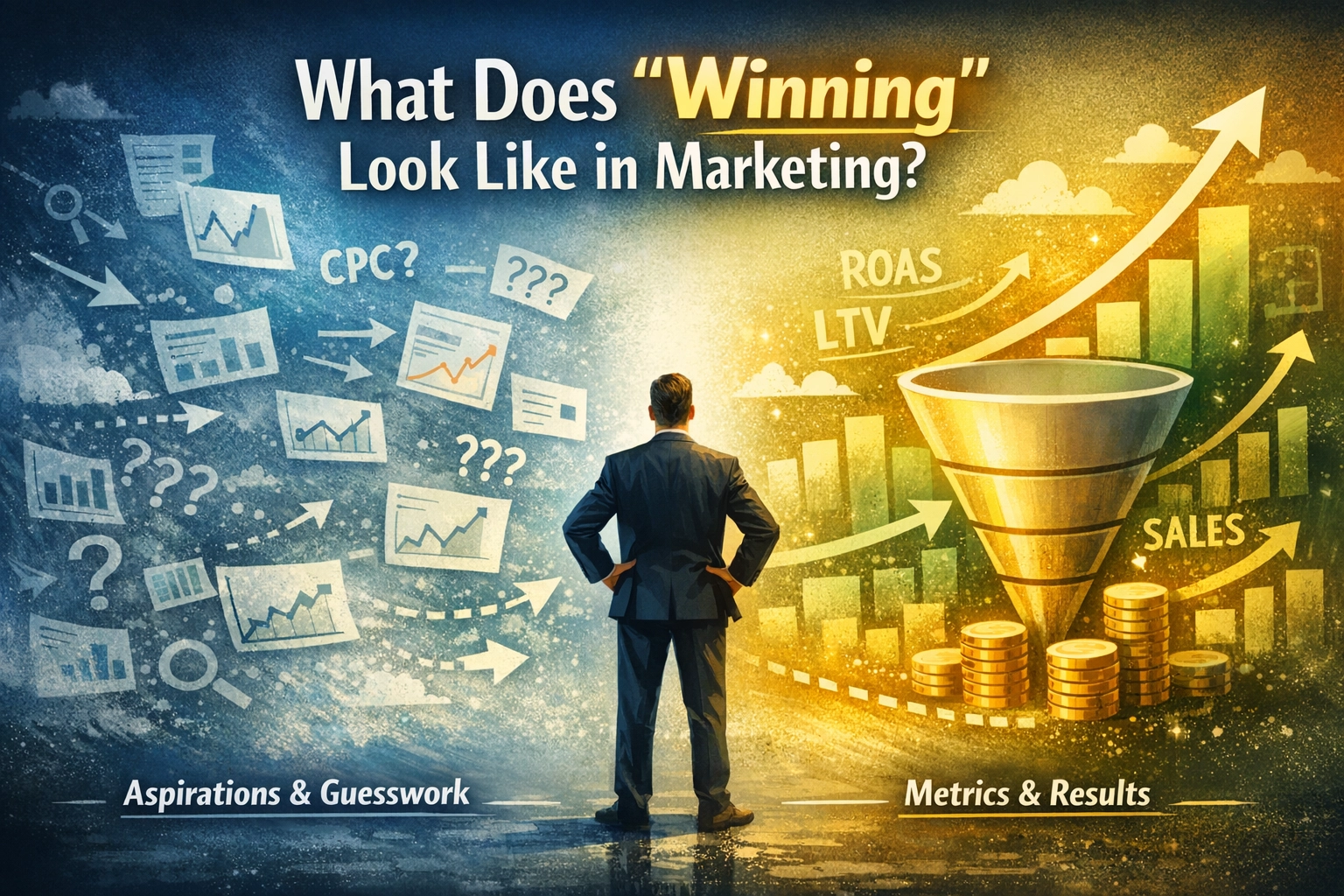
A client asked me something recently that most executives are too proud to say out loud: "How do we know what winning looks like?"
We were three weeks into a new campaign launch. We had just rolled out Google Local Services Ads, paid social lead generation, and an expanded paid search program. There was limited historical data. We were entering new territory for this business.
My answer was honest, and it's the same answer I'd give any service business in the same position: at the beginning, you don't fully know yet.
That's not a failure of planning. It's the reality of marketing — and the sooner leadership teams accept it, the faster they can build something that actually produces predictable revenue.
Most companies think they have a marketing problem. They usually have a measurement problem. You can't optimize what you can't see.
Marketing Is Navigation, Not Blueprint Execution
When launching marketing in a new channel or market, the process is less like following a construction blueprint and more like navigating to a destination you've approached before but haven't driven to from this exact starting point.
You know the general direction. You have experience from similar trips. But along the way, you will almost certainly:
- Take wrong turns and need to course-correct
- Hit unexpected friction points — market conditions, competitive pressure, weak landing page conversion
- Discover faster routes you didn't anticipate going in
Marketing doesn't come with GPS. It comes with experience, pattern recognition, and a disciplined process of iteration. That's a more valuable asset long-term — but it requires patience and realistic expectations from ownership.
The Problem With Aspirational Benchmarks
Early in a campaign, most marketing leaders anchor to targets like 4–5x ROAS, a specific cost per lead, or a revenue goal derived from the annual plan. These benchmarks are important — they define the destination. But they are not guarantees, and treating them as baselines for early performance evaluation is a fast path to making the wrong decisions.
Aspirational metrics are based on:
- Past experience in adjacent industries or similar markets
- Industry benchmarks that represent averages, not your specific situation
- Market assumptions that may not hold in your geography or competitive set
I've run the same campaign structure for the same brand in two markets that looked nearly identical on paper. The results were dramatically different. Not because the strategy was wrong — because marketing performance is shaped by variables that are difficult to model perfectly in advance: consumer sentiment, competitive pressure, brand awareness levels, market maturity, and critically, how well the sales team handles the leads they receive.
The Full Marketing Measurement Model
The goal for every service business is to mature marketing into a fully measurable revenue engine. In that future state, you can track the complete funnel — from media spend to lifetime customer value. Here's what that measurement stack looks like when it's built:
| Metric | Definition | Abbreviation |
|---|---|---|
| Marketing Spend as % of Revenue | Total marketing investment relative to revenue generated | % Rev |
| Media Spend by Channel | Dollar allocation per acquisition channel | $ |
| Cost per Click | Average paid search / social click cost | CPC |
| Website Conversion Rate | Visitors who complete a lead action | CVR % |
| Cost per Lead | Spend ÷ total leads generated | CPL |
| Leads by Channel | Volume attributed to each source | # Leads |
| Close Rate | Sold jobs ÷ leads received | CR % |
| Sales by Channel | Revenue attributed per source | # Sales |
| Average Sale | Revenue per closed job | Avg Sale |
| First Purchase Revenue | Initial transaction value | FPR |
| Return on Ad Spend | Revenue ÷ media spend | ROAS |
| Blended Return on Marketing Spend | Revenue ÷ total marketing investment | ROMS |
| Lifetime Value | Total customer revenue over the relationship | LTV |
| LTV Return on Ad Spend | Full-lifetime revenue ÷ acquisition spend | LTV-ROAS |
This is the fully optimized marketing measurement model. Most service businesses don't start here. Most start with one number: how many leads came in from each channel. That's fine — if you build toward the full model deliberately.
Conversion rate without lead quality context is a vanity metric. Always close the loop to booked revenue. A lower CPL that produces unqualified leads is not a win.
Why You Can't Wait for Perfect Attribution
Ideally, every campaign would launch with full attribution infrastructure in place — CRM wired, call tracking live, lead source tagging clean, and reporting dashboards built. In practice, that level of measurement maturity can take six months or more depending on tech stack complexity.
If you wait until everything is perfect before launching campaigns, you create a new problem: you never generate the data you need to optimize.
Marketing systems require real-world feedback loops. You need campaigns running to:
- Learn actual conversion behavior on your specific landing pages
- Measure lead quality against your actual sales team performance
- Understand channel dynamics in your real markets
- Train Google and Meta's optimization algorithms with real signal
As I covered in detail in How to Know If Your Marketing Spend Is Working, attribution is non-negotiable — but it improves while campaigns are already running, not before them.
The practical answer: build what you can before launch, start with clean lead source tracking at minimum, and add layers of attribution as the infrastructure matures. Don't let perfect be the enemy of operational.
How Long Does It Actually Take?
The question every client asks in month one: "How long before we figure this out?"
The honest answer: more than three weeks, less than a year. Where you land in that range depends on:
- Number of channels running simultaneously
- Existing campaign history and data availability
- Market competitiveness and brand awareness baseline
- Sales process maturity and CRM discipline
- Quality of attribution infrastructure at launch
Some businesses find the optimal path in 60–90 days. Others — particularly those entering new markets or running channels for the first time — require a year of iteration to fully optimize. The variable that matters most isn't time. It's the quality of the learning cycle during that time.
For a deeper look at how CRM infrastructure affects this timeline, see Why Your CRM Is Not Working (And It's Not the Software's Fault).
The Leadership Lesson Nobody Talks About
Looking back on that client conversation, I identified a failure mode I've seen in myself and in marketing leaders broadly: we are often better at selling the destination than explaining the journey.
Vision matters. A clear picture of where growth is going creates alignment and urgency. But vision without honest expectations about the process creates confusion, second-guessing, and premature campaign shutdowns — right before the data starts to get useful.
Strong marketing leadership means communicating three things clearly at every stage:
- Where we are going — the revenue outcome and how marketing contributes to it
- What we expect to learn along the way — the signals we're watching, what early performance tells us, and what it doesn't
- How long the journey realistically takes — and what "on track" looks like at each phase
Winning Is a Process, Not a Metric
Marketing success rarely comes from a single breakthrough moment. It comes from a disciplined system of measurement, iteration, and compounding optimization. Winning, defined properly, looks like:
- Launching campaigns with a clear strategy and baseline measurement in place
- Measuring what matters — lead source, cost per lead, close rate, booked revenue
- Learning quickly from real data and adjusting without overreacting to noise
- Building attribution maturity over time while campaigns are generating signal
- Turning a messy early-stage effort into a predictable, accountable revenue engine
Every marketing leader loves to talk about ROAS targets and channel expansion plans. The real buy-in — from ownership, from sales, from the whole organization — comes when everyone understands the process required to produce those results. That's what executive-level marketing leadership actually looks like.

Brian Redden
Fractional CMO & Founder, Demand Growth Partner. Brian helps established service businesses build the revenue infrastructure, attribution systems, and demand generation engines required for predictable, profitable growth. Learn more →